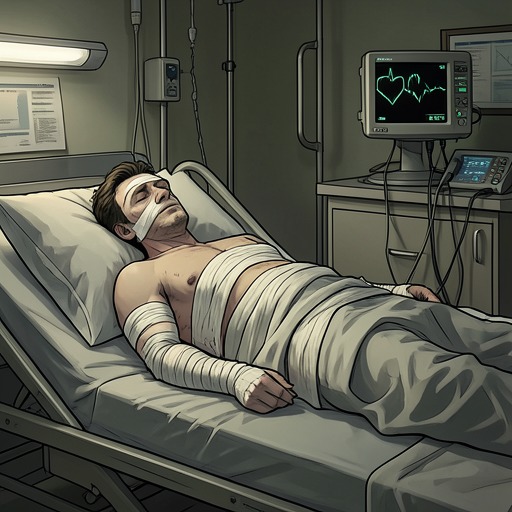
Hakan's breathing tube
Let the Right One InHakan's breathing tube is at once the apparatus sustaining his damaged body and the object he identifies as a way to die. After waking from his attempt to destroy himself with acid, he discovers that a tube runs from a metal socket in his throat to the machinery breathing for him. He tries to unscrew it, but medical staff intervene. Later, when he tugs at it again, a nurse warns that he will be restrained. Its repeated appearance turns an ordinary piece of life-support equipment into the material focus of a struggle over survival, choice, and control.
Construction and Operation
At first Hakan registers the tube through sound and sensation rather than sight. The scene opens in gray blur: he hears hissing beside him and feels his chest filling and emptying in time with it. He cannot tell whether he is at the pool or attached to gas, or whether he is awake at all. His perception is fractured, but the rhythm of the hiss supplies a first clue that breathing is happening without his command.
His body seems inaccessible to him. He cannot properly blink or open his mouth; one eye is gone, and his face is covered in warm, stiffening wax. He can move his right hand, however, and the ability to feel his fingers against his palm briefly reassures him. When he lifts that hand, he finds the tube by following the hard sensation at his chin. A metal socket has been implanted in his throat, with a plastic tube running from it to a grooved metal fitting. The arrangement links the vulnerable point in his body to the machine that breathes for him.
The tube’s mechanics become legible through touch. Hakan understands that this is what he is meant to pull out if he wants to die. The fitting is screwed in; when he turns it, air begins escaping around the seal, and the hiss grows thinner. The small change in sound registers a consequential physical change: his attempt is not merely a thought or gesture, but an action disrupting the connection that keeps him breathing.
Hakan’s Attempt to Remove It
The tube acquires its lethal meaning in the aftermath of Hakan’s acid attack on himself. His memory stops at unscrewing the jar lid, and he realizes that the plan he had carried out failed only because he remained alive. He recalls having seen pictures of women whose faces had been attacked with acid, and he cannot bear either to feel his own face or to see it. The tube offers him a method of completing the death he had expected the acid to bring.
He acts with the limited movement he has: his right hand reaches the fitting and begins to unscrew it. His left hand is no longer available to him as a functioning hand; he senses only a prickling ball of pain where it should be. The contrast matters. Hakan’s attempt at control is concentrated in the one hand he can move, while the body he is trying to direct remains profoundly altered and dependent on the machine.
A door opens, a white-clad figure approaches, and fingers pry his own from the metal. The intervention is immediate and physical: the nurse stops him from loosening the fitting further, and the tube is screwed back into place. Hakan’s fingers give way; the hiss returns. The reversal is audible as well as visible in action—the connection he had begun to undo is restored, and the machinery resumes its work of keeping him alive.
Repeated Intervention and Surveillance
The episode does not end the conflict. Later, while a policeman has left and a nurse remains in the room to watch him, Hakan shakes his head in denial and reaches for the respirator tube again. The nurse jumps up and tears his hand away. The recurrence establishes that the first attempt was not an isolated accident or a single mistaken movement: staff now understand the tube as something Hakan may try to remove again, and his access to it becomes a matter of supervision.
The nurse says that he will be tied up if he tries once more. She frames the restraint as part of the staff’s responsibility: whether or not he wants to live, their job while he is there is to keep him alive, and they will do what they must, even if that means restraining him. Her statement makes the tube part of a wider institutional contest. It is not only a connection between Hakan and a breathing machine; it is also the point around which medical care becomes observation, warning, and the possible limitation of his movement.
Hakan’s inward response sharpens that conflict. He repeats the language of cooperation and thinks that he is no longer a person but a project. The tube therefore marks a distinction between bodily survival and the experience of being treated as a subject. The machine keeps his body functioning, but his perception of care is entangled with being managed by others, watched, and potentially tied down. The evidence does not settle the moral question of whether staff should preserve his life against his wishes; it shows the concrete means by which that disagreement is enacted.
Narrative Significance
The tube is made conspicuous through a sequence of sensory discoveries rather than an external explanation. Hakan begins with grayness, uncertain consciousness, and an unexplained hiss. He then tests what his body can do, locates the socket, traces the plastic line, and understands the fitting’s purpose. The reader learns the object as he does, through touch, sound, and inference. Its ordinary function becomes newly visible at the moment its connection is threatened.
Sound binds the episodes together. At first, the hiss accompanies the machine’s breathing; as Hakan loosens the fitting, it changes and thins; when the nurse restores the connection, the hiss returns. Later, the tube remains the focus of his repeated attempt and the nurse’s watch. This recurrence gives the object a precise dramatic role without making it a symbol detached from its practical use: every change in its condition has immediate consequences for Hakan’s breathing and for the staff’s response.
The breathing tube thus holds together two incompatible meanings. It is indispensable support for a body left severely injured by acid, and, to Hakan, an available instrument for ending a life he believed he had already surrendered. The nurse’s intervention preserves the connection, while her threat of restraint exposes the cost of preserving it against his resistance. The object’s significance lies in that unresolved tension: the same tube sustains Hakan and becomes the contested boundary between his will and other people’s power to keep him alive.